
Passover
2030Thursday, April 18
Quick Facts
- Date
- Thursday, April 18, 2030
- Observed in
- Bosnia & Herzegovina, Israel, Serbia
- Type
- Religious Holiday
What is Passover?
Passover (Hebrew: פֶּסַח, Pesach) is one of the most important Jewish holidays, celebrated for seven days (eight days in the Diaspora) beginning on the 15th of Nisan in the Hebrew calendar, typically falling in March or April. It commemorates the liberation of the Israelites from slavery in ancient Egypt as told in the Book of Exodus.
The name "Passover" refers to how God "passed over" the homes of the Israelites during the tenth plague, sparing their firstborn children while striking those of the Egyptians. Passover is one of the three pilgrimage festivals (Shalosh Regalim) in Judaism, alongside Shavuot and Sukkot, when Jews historically traveled to the Temple in Jerusalem.
When is Passover 2030?
Passover is on Thursday, April 18 in 2030.
2030Thursday, April 18
History & Origin
The story of Passover is told in the Book of Exodus (Shemot). The Israelites had been enslaved in Egypt for generations when God called upon Moses to lead them to freedom. When Pharaoh refused to release the Israelites, God sent ten plagues upon Egypt.
Before the final plague — the death of every firstborn — God instructed the Israelites to mark their doorposts with the blood of a lamb so the Angel of Death would "pass over" their homes. After this devastating plague, Pharaoh finally let the Israelites go.
The Israelites left in such haste that their bread dough did not have time to rise, which is why unleavened bread (matzah) is central to Passover observance. They then crossed the Red Sea (or Sea of Reeds) when God parted the waters, escaping the pursuing Egyptian army.
The historical Passover celebration evolved over centuries. In Temple times, families brought a Paschal lamb to be sacrificed. After the destruction of the Second Temple in 70 CE, the Seder meal and the Haggadah (the text read during the Seder) became the primary means of observance.
How It's Celebrated
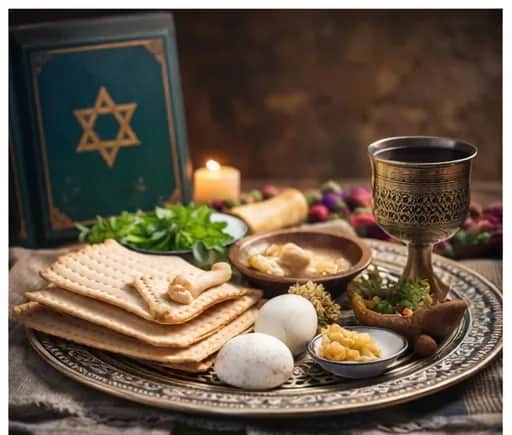
The Seder: The Passover Seder (meaning "order") is the central ritual, a festive meal held on the first night (first two nights in the Diaspora). Families and friends gather to retell the Exodus story using the Haggadah, a special text that guides the evening through prayers, songs, and symbolic foods.
The Seder Plate: The Seder table features a special plate with six symbolic foods: Maror (bitter herbs, symbolizing the bitterness of slavery), Charoset (a sweet paste representing the mortar used by slaves), Karpas (a green vegetable dipped in salt water, representing tears), Zeroa (a roasted shank bone, symbolizing the Paschal sacrifice), Beitzah (a roasted egg, symbolizing mourning and renewal), and Chazeret (additional bitter herbs).
Matzah: During Passover, Jews abstain from eating chametz (leavened bread) and instead eat matzah (unleavened flatbread), recalling the haste of the Exodus.
Four Cups of Wine: Four cups of wine are drunk during the Seder, corresponding to the four expressions of redemption in Exodus.
The Four Questions: The youngest child at the Seder asks the Mah Nishtanah ("Why is this night different from all other nights?"), prompting the retelling of the Exodus story.
Elijah's Cup: A cup of wine is set aside for the Prophet Elijah, and the door is opened during the Seder to welcome him, symbolizing hope for future redemption.
Where It's Observed
Passover is a public holiday in 3 countries. In 2030, it falls on Thursday, April 18.
Fun Facts
- Passover is sometimes called the Festival of Freedom (Chag HaHerut) or the Festival of Matzot (Chag HaMatzot)
- The Last Supper of Jesus and his disciples is widely believed by scholars to have been a Passover Seder
- During Passover, observant Jews remove all chametz (leavened products) from their homes in a ritual search called Bedikat Chametz
- The Haggadah has been printed in more editions than almost any other Jewish text, with thousands of versions created throughout history
- In Israel, Passover is observed for 7 days, while in the Diaspora it is observed for 8 days
- The tradition of hiding the Afikoman (a piece of matzah) for children to find is one of the most beloved Seder customs
Frequently Asked Questions
What is Passover?
Passover (Pesach) is a major Jewish holiday lasting seven or eight days that commemorates the liberation of the Israelites from slavery in ancient Egypt. It is celebrated with the Seder meal, the eating of matzah (unleavened bread), and the retelling of the Exodus story.
When is Passover celebrated?
Passover begins on the 15th of Nisan in the Hebrew calendar, typically falling in March or April. It lasts seven days in Israel and eight days in the Diaspora.
What is a Passover Seder?
The Seder is a ritual feast held on the first night (or first two nights) of Passover. Families gather to retell the Exodus story using the Haggadah, a special text, while eating symbolic foods and drinking four cups of wine.
Why do Jews eat matzah on Passover?
Matzah (unleavened bread) is eaten because when the Israelites fled Egypt, they left in such haste that their bread dough did not have time to rise. Eating matzah commemorates this urgency and the transition from slavery to freedom.
What is on the Seder plate?
The Seder plate contains six symbolic items: maror (bitter herbs), charoset (sweet paste), karpas (green vegetable), zeroa (shank bone), beitzah (roasted egg), and chazeret (additional bitter herbs). Each symbolizes an aspect of the Exodus story.
Travel Inspiration
Planning a trip around Passover? Explore our travel guides for destinations where this holiday is celebrated.


