
Corpus Christi
2026Thursday, June 4
Quick Facts
- Date
- Thursday, June 4, 2026
- Observed in
- Austria, Bolivia, Brazil, Switzerland, Colombia +12 more
- Type
- Religious Holiday
What is Corpus Christi?
Corpus Christi, Latin for "Body of Christ," is a Catholic solemnity celebrating the Real Presence of Jesus Christ in the Eucharist. The feast is observed on the Thursday following Trinity Sunday, which falls 60 days after Easter. In some countries, the celebration is transferred to the following Sunday to accommodate work schedules.
The feast emphasizes the Catholic belief in transubstantiation - that the bread and wine used in the Mass become the actual body and blood of Christ. Unlike Maundy Thursday, which commemorates the institution of the Eucharist in a somber Holy Week context, Corpus Christi is a joyful celebration of this central mystery of the Catholic faith.
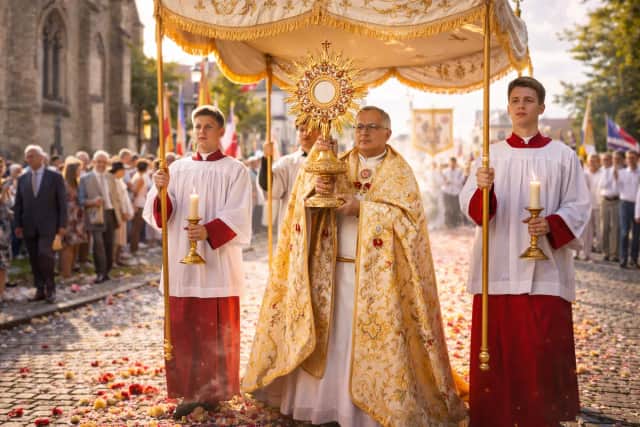
Corpus Christi is marked by elaborate processions through streets decorated with flowers, banners, and religious symbols. The Blessed Sacrament is carried in an ornate vessel called a monstrance, while the faithful follow in prayer and song. These processions are among the most visually spectacular events in the Catholic liturgical year and attract both believers and tourists in many countries.
When is Corpus Christi 2026?
Corpus Christi is on Thursday, June 4 in 2026. Check the dates and days for other years in the table below.
History & Origin
The Feast of Corpus Christi originated in the 13th century, largely through the efforts of Saint Juliana of Liège, a Belgian nun who had visions calling for a special feast to honor the Eucharist. She spent much of her life promoting this cause, facing considerable opposition but eventually gaining support from the Bishop of Liège.
In 1246, the Diocese of Liège became the first to celebrate the feast. The movement gained momentum when Jacques Pantaléon, a former archdeacon of Liège who had supported Juliana's cause, became Pope Urban IV in 1261. Following a reported Eucharistic miracle at Bolsena, Italy, where a consecrated host allegedly began to bleed, Pope Urban IV instituted Corpus Christi as a universal feast of the Church in 1264 with the papal bull "Transiturus."
The great theologian Saint Thomas Aquinas was commissioned to compose the liturgical texts for the feast, including the famous hymns "Pange Lingua," "Tantum Ergo," and "O Salutaris Hostia," which remain in use today. The outdoor processions that became the hallmark of Corpus Christi developed in the 14th century, particularly in Germany, and spread throughout Catholic Europe.
The feast was suppressed in many Protestant regions during the Reformation but remained a major celebration in Catholic countries. The Counter-Reformation actually strengthened its observance as a visible affirmation of Catholic belief in the Real Presence.
How It's Celebrated
Corpus Christi is celebrated with distinctive traditions that vary by region but share common elements of public witness and elaborate decoration.
The Eucharistic Procession: The centerpiece of Corpus Christi is the procession carrying the Blessed Sacrament through the streets. The consecrated host is displayed in a monstrance (a decorative vessel with a glass window) held by a priest under an ornate canopy. The faithful follow in procession, often organized by parish groups, religious orders, and confraternities.
Flower Carpets (Alfombras): In Spain, Portugal, Latin America, and parts of Germany, intricate carpets of flowers, colored sawdust, and other materials are created along the procession route. These temporary artworks can stretch for kilometers and require many hours of community effort. The town of La Orotava in Tenerife is particularly famous for its elaborate designs.
Four Altars: Traditionally, the procession stops at four outdoor altars set up along the route, where readings from the four Gospels are proclaimed and benediction is given.
First Communion: In many Catholic countries, children receive their First Holy Communion on Corpus Christi or the preceding Sunday, making it a major family celebration.
Decorated Streets: Buildings along procession routes are decorated with banners, tapestries, and religious images. Windows may display white cloths and candles.
Regional Traditions: In Toledo, Spain, the historic procession through medieval streets is particularly famous. In Cologne, Germany, boats on the Rhine form part of the celebration. In Poland, young girls in white dresses scatter flower petals before the Blessed Sacrament.
Religious Significance
Corpus Christi holds profound theological importance in Catholic teaching, centering on the doctrine of the Real Presence.
Transubstantiation: The feast affirms the Catholic belief that during the Mass, the bread and wine become the actual Body and Blood of Christ, while retaining the appearances (or "accidents") of bread and wine. This transformation, called transubstantiation, makes Christ truly present in the Eucharist.
Public Proclamation: Unlike most sacraments celebrated within churches, Corpus Christi takes the Eucharist into the streets, publicly proclaiming the Church's faith. This "going out" represents both evangelization and a statement of religious identity.
Adoration: The feast promotes Eucharistic adoration - the practice of contemplating and worshipping Christ present in the consecrated host. Many parishes hold extended periods of adoration around Corpus Christi.
Unity of the Church: The Eucharist is called the "source and summit" of Catholic life. Corpus Christi celebrates how the sacrament unifies believers into one body - the Church - through sharing in Christ's body.
Thomas Aquinas's Theology: The hymns written by Aquinas for Corpus Christi express sophisticated Eucharistic theology in poetic form. "Tantum Ergo" and "Pange Lingua" are still sung at Benediction services worldwide.
Distinction from Holy Thursday: While Holy Thursday commemorates the institution of the Eucharist during Christ's final meal with his apostles, that observance is marked by the solemnity of Holy Week. Corpus Christi provides an opportunity for joyful, festive celebration of the same mystery.
Where It's Observed
Corpus Christi is a public holiday in 13 countries. In 2026, it falls on Thursday, June 4.
Travel Tips
Corpus Christi (Thursday, 60 days after Easter) is a public holiday in several countries, affecting travel plans:
Public Holiday Countries: Corpus Christi is a public holiday in Austria, parts of Germany (Baden-Württemberg, Bavaria, Hesse, North Rhine-Westphalia, Rhineland-Palatinate, Saarland), parts of Switzerland, Poland, Portugal, Brazil, and several Latin American countries.
Procession Routes: If you want to witness the processions, research specific cities and times. Famous celebrations include Toledo (Spain), Cologne (Germany), Cusco (Peru), and various towns in Bavaria and Austria.
Flower Carpets: To see the elaborate flower carpets, arrive early - they're often completed overnight and may be walked upon during the procession. La Orotava (Tenerife), Sitges (Spain), and various Portuguese towns are renowned for this tradition.
Shop Closures: In regions where Corpus Christi is a public holiday, expect Sunday-like closures. Plan shopping accordingly.
Crowds: Popular procession sites can be very crowded. Arrive early for good viewing positions, and be respectful of the religious nature of the event.
Bridge Days: When Corpus Christi falls on Thursday, many people take Friday off to create a long weekend. This increases travel volumes and accommodation prices.
Weather: Corpus Christi falls in late May or June, typically offering warm weather in Europe. However, processions proceed rain or shine, so pack accordingly.
Photography: While generally permitted, be respectful when photographing religious ceremonies. Some moments may require silence and reverence.
Fun Facts
- The feast was inspired by visions experienced by Saint Juliana of Liège in the 13th century
- Saint Thomas Aquinas wrote the hymns for Corpus Christi, including the famous 'Tantum Ergo'
- The flower carpets in La Orotava, Tenerife, can cover over 100,000 square feet and take hundreds of volunteers to create
- A reported Eucharistic miracle at Bolsena, Italy, helped convince Pope Urban IV to establish the feast
- The word 'monstrance' comes from Latin 'monstrare' meaning 'to show'
- In medieval England, Corpus Christi was associated with mystery plays performed by trade guilds
- The feast always falls between May 21 and June 24, depending on when Easter occurs
- In Poland, young girls scatter flower petals before the Blessed Sacrament during processions
- Cologne's Corpus Christi procession includes boats on the Rhine River called 'Mülheimer Gottestracht'
- In Cusco, Peru, Corpus Christi blends Catholic tradition with Incan heritage in a unique syncretistic celebration
- The papal bull establishing Corpus Christi, 'Transiturus,' was issued in 1264 but initially had limited effect
- Some towns in Bavaria still celebrate with traditional Corpus Christi riders on decorated horses
Frequently Asked Questions
When is Corpus Christi 2026?
Corpus Christi 2026 falls on Thursday, June 4th. It is celebrated 60 days after Easter Sunday (which is April 5th in 2026), on the Thursday after Trinity Sunday.
Why is Corpus Christi always on a Thursday?
Corpus Christi is celebrated on Thursday to echo Holy Thursday, when Jesus instituted the Eucharist at the Last Supper. The Thursday after Trinity Sunday was chosen to provide a more festive context than Holy Week allows.
Is Corpus Christi a public holiday?
Yes, in some countries and regions. It's a public holiday in Austria, parts of Germany and Switzerland, Poland, Portugal, Brazil, and several Latin American countries. It is not a public holiday in France, Italy, Spain (nationally), the UK, or the US.
What is the difference between Corpus Christi and Holy Thursday?
Both celebrate the Eucharist, but Holy Thursday commemorates its institution during the somber context of Holy Week, while Corpus Christi is a joyful, festive celebration that takes place outside of Lent, featuring public processions and celebrations.
What is a monstrance?
A monstrance is an ornate vessel used to display the consecrated Eucharistic host for adoration or procession. It typically features a glass or crystal window surrounded by decorative rays, often made of gold or gilded metal.
Why are there flower carpets on Corpus Christi?
Flower carpets (alfombras) are created to honor Christ present in the Eucharist as it passes through the streets. The tradition dates back centuries and represents the community's devotion and artistic expression of faith.
Do non-Catholics attend Corpus Christi processions?
Yes, many Corpus Christi processions, especially in tourist areas, attract visitors of all backgrounds who come to witness the cultural and artistic elements of the celebration. Respectful observation is generally welcomed.
Are shops open on Corpus Christi?
In regions where Corpus Christi is a public holiday, most shops and businesses are closed. In other areas, normal business hours apply. Check local regulations for your specific destination.
Travel Inspiration
Planning a trip around Corpus Christi? Explore our travel guides for destinations where this holiday is celebrated.


