
Struggle for Freedom and Democracy Day
2027Wednesday, November 17
Quick Facts
- Date
- Wednesday, November 17, 2027
- Observed in
- Czech Republic, Slovakia
- Type
- National Holiday
What is Struggle for Freedom and Democracy Day?
The Struggle for Freedom and Democracy Day (Den boja za slobodu a demokraciu) is a public holiday in Slovakia and the Czech Republic observed on November 17th. It commemorates two pivotal events in Czechoslovak history: the Nazi suppression of student demonstrations in 1939 and the beginning of the Velvet Revolution in 1989 that peacefully ended communist rule.
This dual commemoration honors both the students who stood against Nazi occupation during World War II and those who sparked the non-violent revolution that brought down the communist regime. The 1989 Velvet Revolution is one of history's most successful peaceful transitions from authoritarianism to democracy.
November 17th holds deep significance as International Students' Day, established in memory of Czech students persecuted by Nazis in 1939. Fifty years later, on the same date, a student demonstration in Prague became the catalyst for the revolution that transformed Czechoslovakia and inspired democratic movements worldwide.
When is Struggle for Freedom and Democracy Day 2027?
Struggle for Freedom and Democracy Day is on Wednesday, November 17 in 2027. Check the dates and days for other years in the table below.
History & Origin
1939: Nazi Repression and International Students' Day
On October 28, 1939, Czech students held demonstrations against the Nazi occupation of Czechoslovakia. The Nazis responded with brutal force—on November 17, 1939, they closed all Czech universities, executed nine student leaders, and sent over 1,200 students to concentration camps.
In 1941, the International Students' Council declared November 17th as International Students' Day to commemorate this tragedy and honor student resistance worldwide.
1989: The Velvet Revolution Begins
Fifty years later, on November 17, 1989, a legally permitted student demonstration commemorating the 1939 events took place in Prague. Approximately 15,000 students marched peacefully, but riot police brutally dispersed the crowd on Národní třída (National Avenue).
The Spark That Changed History
The police violence against peaceful students outraged the Czechoslovak public. Within days:
- Theaters went on strike and became centers of opposition
- Civic Forum (led by Václav Havel) and Public Against Violence (in Slovakia) formed
- Mass demonstrations grew, with 500,000 people gathering in Prague's Letná Park
- Workers joined the movement, threatening a general strike
The Fall of Communism
The communist regime, faced with massive peaceful resistance, began to crumble:
- November 24: The entire Communist Party leadership resigned
- November 28: The party agreed to end its monopoly on power
- December 10: A non-communist government was formed
- December 29: Václav Havel was elected President
The transition was remarkably peaceful—hence the name "Velvet Revolution" (Sametová revoluce in Czech, Nežná revolúcia in Slovak).
How It's Celebrated
Official Commemorations
Both Slovakia and the Czech Republic hold significant ceremonies:
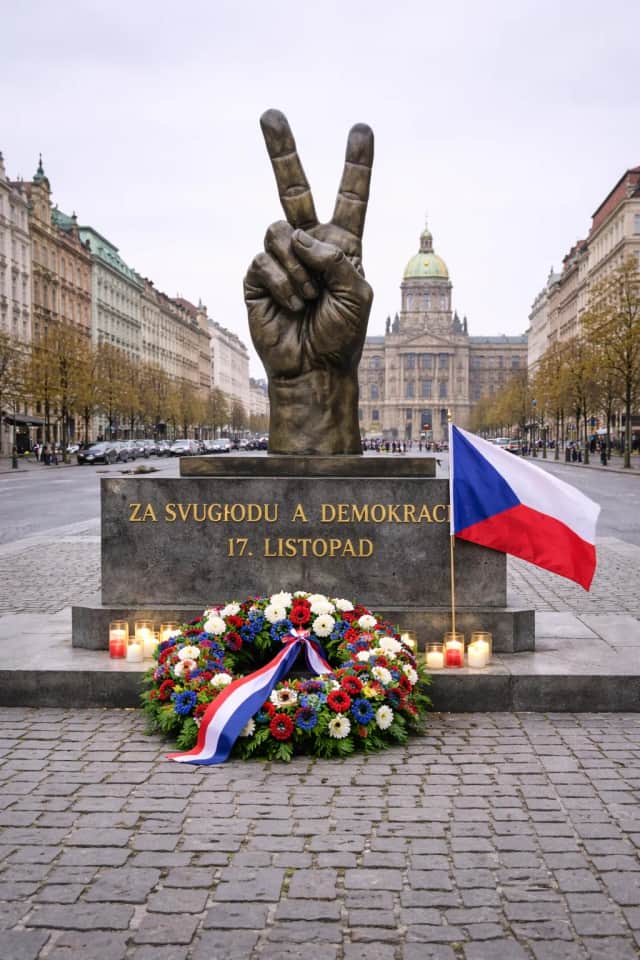
- State officials lay wreaths at memorials and monuments
- Presidential addresses to the nation
- Special sessions of parliament
- Honoring of surviving participants and dissidents
Prague: Center of Remembrance
- Národní třída: The main site where police attacked students in 1989. A bronze hands memorial marks the spot where the violence began
- Wenceslas Square: Site of the massive 1989 demonstrations; people gather to commemorate
- Prague Castle: Official ceremonies with the President
Bratislava Commemorations
- Ceremonies at key locations from the 1989 protests
- Cultural events honoring those who fought for freedom
- Museum exhibitions about the revolution
Educational Programs
- Schools organize special lessons about both 1939 and 1989 events
- Documentary film screenings
- Meetings between students and revolution participants
- Public discussions about democracy and freedom
Traditional Activities
- Lighting candles at memorial sites
- Ringing of keys (symbolizing the 1989 protests when people jingled keys to "ring out" communism)
- Playing songs from the revolution, especially Marta Kubišová's "Modlitba pro Martu" (Prayer for Marta)
- Wearing tricolor ribbons (Czech: red, white, blue)
Where It's Observed
Struggle for Freedom and Democracy Day is a public holiday in 2 countries. In 2027, it falls on Wednesday, November 17.
Fun Facts
- The Velvet Revolution lasted only 10 days from the first demonstration to the resignation of the Communist Party leadership
- Václav Havel, a playwright and dissident, went from prison to the presidency in less than a year
- The term 'Velvet Revolution' was coined to describe how smoothly power was transferred without violence
- The revolution was partly inspired by events in neighboring Poland and Hungary, where communist regimes were already weakening
- During the largest demonstration on November 25, 1989, an estimated 500,000 people gathered in Prague's Letná Park
- The sound of jingling keys became a symbol of the revolution—people rattled them to 'ring out' the communist regime
- Marta Kubišová's song 'Modlitba pro Martu' (Prayer for Marta), banned during communism, became the revolution's anthem
- The Velvet Revolution inspired the term 'Velvet Divorce' for the peaceful separation of Czechoslovakia into Czech Republic and Slovakia in 1993
Frequently Asked Questions
When is the Struggle for Freedom and Democracy Day?
The Struggle for Freedom and Democracy Day is observed on November 17th in both Slovakia and the Czech Republic. It commemorates both the 1939 Nazi suppression of students and the 1989 Velvet Revolution.
What was the Velvet Revolution?
The Velvet Revolution was a non-violent transition of power in Czechoslovakia from communist rule to democracy in November 1989. It began with a student demonstration on November 17th and ended with the resignation of the communist government and the election of Václav Havel as president.
Why is it called the Velvet Revolution?
It is called the 'Velvet Revolution' because the transition from communism to democracy was remarkably smooth and peaceful, without significant violence—as soft as velvet.
Why is November 17th also International Students' Day?
November 17th became International Students' Day in 1941 to commemorate Czech students who were persecuted by Nazis on this date in 1939. Nine student leaders were executed and over 1,200 students were sent to concentration camps.
Is November 17th a public holiday?
Yes, November 17th is a public holiday in both Slovakia and the Czech Republic. Banks, schools, and most businesses are closed.
Who was Václav Havel?
Václav Havel was a Czech playwright, dissident, and political leader. He was a leading figure in the Velvet Revolution and became the last president of Czechoslovakia and the first president of the Czech Republic.
Travel Inspiration
Planning a trip around Struggle for Freedom and Democracy Day? Explore our travel guides for destinations where this holiday is celebrated.


Where to Stay in Bratislava for the First Time
Read more →
Bratislava in 5 Days: Spring Guide 2026
Read more →
Prague Itinerary for First-Time Visitors (5 Days)
Read more →
Backpacking Eastern Europe: Ultimate Tips and Route Guide
Read more →