
St. Nicholas's Day
2031Saturday, December 6
Quick Facts
- Date
- Saturday, December 6, 2031
- Observed in
- Austria, Belgium, Switzerland, Czech Republic, Germany +14 more
- Type
- Religious Holiday
What is St. Nicholas's Day?
St. Nicholas's Day honors St. Nicholas of Myra (270-343 AD), one of the most beloved and venerated saints in Christian history. The feast is celebrated on December 6th (his death anniversary) and May 9th in Bari, Italy (celebrating the translation of his relics).
St. Nicholas was a 4th-century Greek bishop known for his generosity and miracles. He is the patron saint of children, sailors, merchants, and the city of Bari. His legendary gift-giving inspired the modern figure of Santa Claus (derived from the Dutch "Sinterklaas").
The Basilica di San Nicola in Bari houses his relics, making it one of the most important pilgrimage sites for both Catholic and Orthodox Christians.
When is St. Nicholas's Day 2031?
St. Nicholas's Day is on Saturday, December 6 in 2031. Check the dates and days for other years in the table below.
History & Origin
St. Nicholas was born around 270 AD in Patara, Lycia (modern-day Turkey). He became Bishop of Myra and was known for his piety, generosity, and miraculous deeds during his lifetime.
After his death on December 6, 343 AD, his tomb in Myra became a pilgrimage site. In 1087, Italian sailors from Bari transported his relics to protect them from Turkish conquest. The relics arrived in Bari on May 9, 1087, an event still celebrated as the Festa di San Nicola.
The Basilica di San Nicola was constructed specifically to house his remains, completed in 1197. The saint's tomb produces a clear liquid called "manna" or "myrrh of St. Nicholas," believed to have miraculous properties.
His fame spread throughout Europe, making him one of the most popular saints of the Middle Ages.
How It's Celebrated
Bari, Italy: The main celebrations occur on May 7-9 with the Festa di San Nicola. A statue of the saint is carried from the Basilica to a boat, recreating the arrival of his relics. Fireworks, processions, and religious ceremonies fill the city.
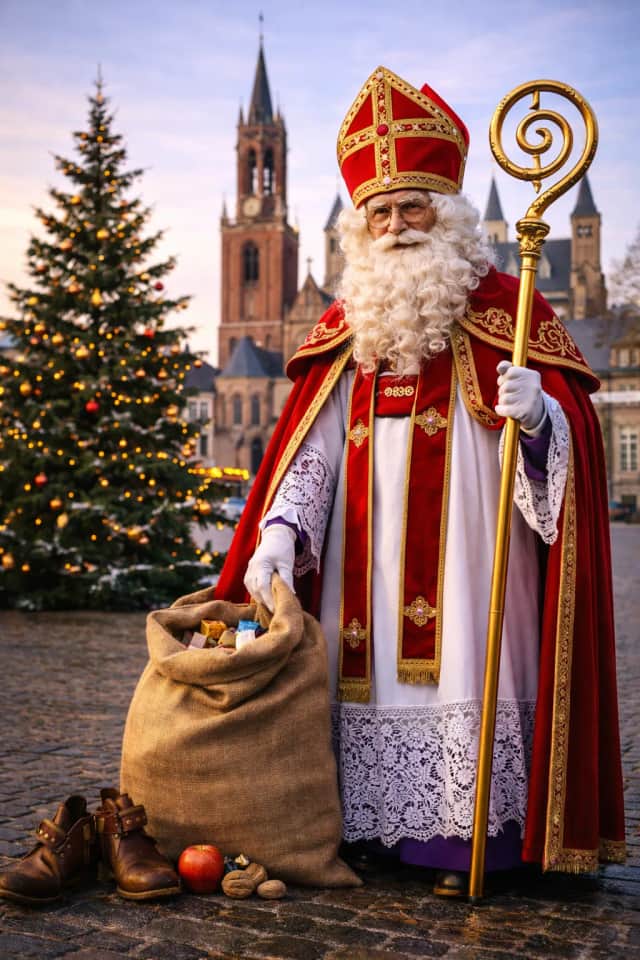
December 6th traditions: In many European countries, children leave shoes or stockings out the night before, hoping St. Nicholas will fill them with treats and small gifts.
Netherlands and Belgium: Sinterklaas arrives by steamboat from Spain in mid-November, accompanied by his helpers. Children receive gifts on December 5th (Sinterklaasavond).
Germany and Austria: St. Nikolaus visits children on December 6th, often accompanied by Krampus (a fearsome companion who punishes naughty children).
Orthodox celebrations: Many Orthodox churches celebrate St. Nicholas on December 19th (Julian calendar), with special liturgies and veneration of icons.
Where It's Observed
St. Nicholas's Day is a public holiday in 1 country. In 2031, it falls on Saturday, December 6.
Fun Facts
- St. Nicholas is the inspiration for Santa Claus, derived from the Dutch Sinterklaas
- His relics were taken from Myra to Bari in 1087 by Italian sailors to protect them from Turkish invasion
- The tomb of St. Nicholas produces a liquid called manna believed to have healing properties
- He is one of the few saints venerated by both Catholic and Orthodox Christians
- The three golden balls symbol of pawnbrokers comes from the legend of St. Nicholas giving gold to three poor sisters
- In Bari, the Festa di San Nicola in May attracts over 100,000 pilgrims annually
- St. Nicholas was present at the Council of Nicaea in 325 AD according to tradition
- His feast day on December 6th predates and influenced Christmas gift-giving traditions
Frequently Asked Questions
Why is St. Nicholas celebrated on two different dates?
December 6th commemorates his death in 343 AD, while May 9th (celebrated mainly in Bari) marks the arrival of his relics from Myra to Bari in 1087, known as the Translation of the Relics.
How did St. Nicholas become Santa Claus?
Dutch settlers brought the Sinterklaas tradition to America. Over time, Sinterklaas evolved into Santa Claus, combining with other Christmas traditions to create the modern gift-giving figure.
Where are St. Nicholas's relics today?
The majority of his relics are in the Basilica di San Nicola in Bari, Italy. Some fragments are in churches worldwide, including St. Nicholas Church in Demre, Turkey (his original burial site).
What is the manna of St. Nicholas?
A clear, odorless liquid that seeps from St. Nicholas's bones. It is collected annually on May 9th in Bari and distributed to pilgrims. Many believe it has miraculous healing properties.
Why do children receive gifts on St. Nicholas Day?
This tradition comes from the legend of St. Nicholas secretly giving gold coins to three poor sisters for their dowries. His generosity inspired the custom of gift-giving to children.
Is St. Nicholas Day a public holiday?
It varies by country. It is not a public holiday in most places, but is widely celebrated in the Netherlands, Belgium, Germany, Austria, and parts of Italy, especially Bari.
Travel Inspiration
Planning a trip around St. Nicholas's Day? Explore our travel guides for destinations where this holiday is celebrated.


Where to Stay in Prague: Best Neighborhoods & Accommodations
Read more →
Where to Stay in Vienna: Best Neighborhoods & Accommodations
Read more →
Where to Stay in Berlin for the First Time
Read more →
Where to Stay in Bern: Best Hotels & Neighborhoods Guide
Read more →