
Rosh Hashanah
2030Saturday, September 28
Quick Facts
- Date
- Saturday, September 28, 2030
- Observed in
- Bosnia & Herzegovina, Israel
- Type
- Religious Holiday
What is Rosh Hashanah?
Rosh Hashanah (Hebrew: ראש השנה, meaning "Head of the Year") is the Jewish New Year, one of the holiest days in the Jewish calendar. It is celebrated on the 1st and 2nd of Tishrei, typically falling in September or October, and marks the beginning of the High Holy Days (Yamim Noraim, or "Days of Awe"), a ten-day period of introspection and repentance culminating in Yom Kippur.
According to Jewish tradition, Rosh Hashanah commemorates the creation of the world — or more specifically, the creation of Adam and Eve, the first human beings. It is a day of divine judgment when, according to tradition, God reviews the deeds of every person and inscribes their fate for the coming year in the Book of Life.
When is Rosh Hashanah 2030?
Rosh Hashanah is on Saturday, September 28 in 2030.
2030Saturday, September 28
History & Origin
Rosh Hashanah has its origins in the Torah (Leviticus 23:23-25), where it is referred to as Yom Teruah (Day of Blowing/Shouting), a day of rest marked by the blowing of trumpets. The Torah does not explicitly call it "New Year" — that title developed in the rabbinic period as the holiday's significance expanded.
The Mishnah (compiled around 200 CE) identifies four new years in the Jewish calendar, with the 1st of Tishrei being the new year for the counting of calendar years, sabbatical years, and jubilee years.
Over centuries, Rosh Hashanah evolved from a single day of trumpet blasts into a two-day festival observed both in Israel and the Diaspora. The liturgy became increasingly elaborate, with special prayers (Unetaneh Tokef, Avinu Malkeinu) and piyyutim (liturgical poems) emphasizing themes of divine kingship, judgment, and repentance.
The practice of Tashlich — casting bread crumbs into flowing water to symbolically cast off sins — became widespread in the Middle Ages and remains popular today.
How It's Celebrated
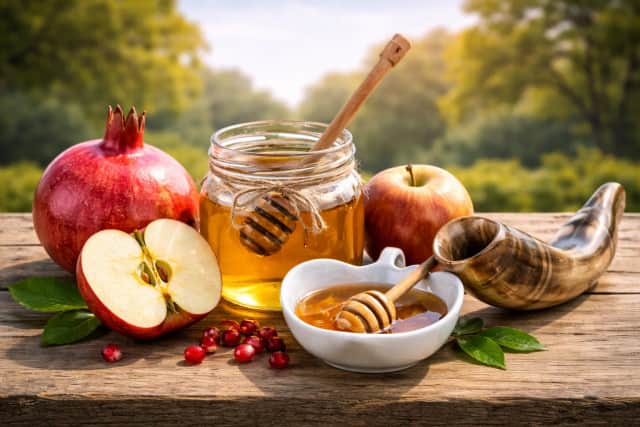
Shofar Blowing: The sounding of the shofar (ram's horn) is the central mitzvah (commandment) of Rosh Hashanah. It is blown in a series of specific patterns — tekiah (long blast), shevarim (three broken blasts), and teruah (nine short blasts) — totaling 100 blasts during the service. The shofar serves as a spiritual wake-up call to repentance.
Symbolic Foods: The Rosh Hashanah table features foods with symbolic meanings. Apples dipped in honey represent hopes for a sweet new year. Round challah (instead of the usual braided shape) symbolizes the cycle of the year and God's crown. Pomegranates are eaten with the wish that one's merits be as plentiful as the seeds.
Tashlich: On the first afternoon of Rosh Hashanah, many Jews walk to a body of flowing water and symbolically cast their sins into the water by tossing bread crumbs, reciting prayers of repentance.
Greetings: The traditional greeting is "Shanah Tovah" (שנה טובה, "A Good Year") or "Shanah Tovah u'Metukah" ("A Good and Sweet Year"). Greeting cards are exchanged.
Synagogue Services: Extended prayer services are held, featuring the special Machzor (High Holiday prayer book) with unique prayers like Unetaneh Tokef ("Let us speak of the holiness of this day").
White Attire: Many Jews wear white clothing to symbolize purity and renewal.
Where It's Observed
Rosh Hashanah is a public holiday in 2 countries. In 2030, it falls on Saturday, September 28.
Fun Facts
- Rosh Hashanah is one of only two days celebrated for two days both in Israel and the Diaspora (the other being certain fast days)
- The shofar is traditionally made from a ram's horn, recalling the ram sacrificed in place of Isaac (the Binding of Isaac)
- Exactly 100 shofar blasts are sounded during the Rosh Hashanah services
- The round challah eaten on Rosh Hashanah symbolizes the cyclical nature of the year and has no beginning or end
- Rosh Hashanah falls on the first day of the seventh month (Tishrei) of the Hebrew calendar, not the first month (Nisan)
- The greeting Shanah Tovah has been found in Jewish letters dating back to the medieval period
Frequently Asked Questions
What is Rosh Hashanah?
Rosh Hashanah is the Jewish New Year, celebrated on the 1st and 2nd of Tishrei (September/October). It marks the creation of the world in Jewish tradition and begins the High Holy Days, a period of introspection leading to Yom Kippur.
When is Rosh Hashanah?
Rosh Hashanah falls on the 1st and 2nd of Tishrei in the Hebrew calendar, typically in September or October.
What is the shofar?
The shofar is a ram's horn blown during Rosh Hashanah services. It serves as a spiritual call to repentance. A total of 100 blasts are sounded in specific patterns: tekiah, shevarim, and teruah.
Why do Jews eat apples and honey on Rosh Hashanah?
Apples dipped in honey are eaten on Rosh Hashanah as a symbol of the wish for a sweet new year. This is one of several symbolic foods on the holiday table.
What is Tashlich?
Tashlich is a ceremony held on the first afternoon of Rosh Hashanah where Jews walk to flowing water and symbolically cast off their sins by tossing bread crumbs into the water while reciting prayers of repentance.
Travel Inspiration
Planning a trip around Rosh Hashanah? Explore our travel guides for destinations where this holiday is celebrated.


