
Inauguration Day
Quick Facts
- Observed in
- United States
- Type
- Regional Holiday
What is Inauguration Day?
Inauguration Day is a federal holiday observed in Washington, D.C. and surrounding areas every four years on January 20, when a new or re-elected President of the United States takes the oath of office. It marks the formal beginning of a new presidential term.
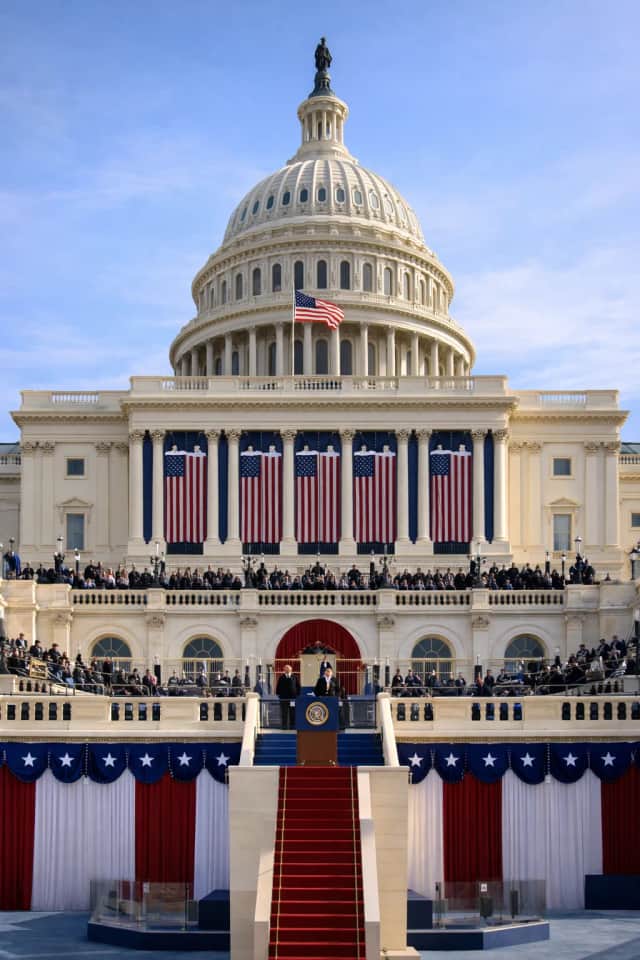
The ceremony takes place at the United States Capitol, where the President-elect is sworn in by the Chief Justice of the Supreme Court. The Vice President is sworn in first, followed by the President, who recites the oath prescribed by the Constitution.
Inauguration Day is a federal holiday specifically for the D.C. metropolitan area, including parts of Maryland and Virginia. Federal employees in the region receive the day off. When January 20 falls on a Sunday, the official oath is taken privately on that day, and the public ceremony is held on Monday, January 21.
History & Origin
The original inauguration date was March 4, as specified by the Constitution. George Washington's first inauguration took place on April 30, 1789, in New York City due to delays in organizing the new government. His second inauguration, and all subsequent ones until 1933, were held on March 4.
The 20th Amendment to the Constitution, ratified on January 23, 1933, moved the inauguration date from March 4 to January 20, shortening the lame-duck period between election and swearing-in. The first January 20 inauguration was Franklin D. Roosevelt's second inauguration in 1937.
When January 20 falls on a Sunday, the President takes the oath privately on Sunday and the public ceremony is held on Monday. This has happened several times, including for Presidents Eisenhower (1957), Reagan (1985), and Obama (2013).
The tradition of the inaugural address dates back to George Washington, though his second inaugural address was the shortest in history at just 135 words. William Henry Harrison gave the longest at 8,445 words in 1841 — and died of pneumonia 31 days later.
How It's Celebrated
Swearing-In Ceremony: The President takes the oath of office at the U.S. Capitol, placing one hand on a Bible and reciting: \"I do solemnly swear that I will faithfully execute the Office of President of the United States, and will to the best of my ability, preserve, protect and defend the Constitution of the United States.\"
Inaugural Address: The newly sworn-in President delivers a speech outlining their vision for the country. Famous addresses include Lincoln's \"with malice toward none\" (1865), Kennedy's \"ask not what your country can do for you\" (1961), and Obama's \"Yes we can\" themes (2009).
Inaugural Parade: Following the ceremony, the President leads a parade down Pennsylvania Avenue from the Capitol to the White House. The parade features military units, marching bands, and floats from all 50 states.
Inaugural Balls: In the evening, multiple inaugural balls are held across Washington, D.C. The President and First Lady attend several balls, traditionally sharing a first dance.
Morning Church Service: Many Presidents attend a prayer service on the morning of Inauguration Day, a tradition dating back to Franklin D. Roosevelt.
Where It's Observed
Fun Facts
- The 20th Amendment moved Inauguration Day from March 4 to January 20, first taking effect for Franklin D. Roosevelt's second inauguration in 1937
- William Henry Harrison's inaugural address in 1841 was the longest at 8,445 words — he died of pneumonia just 31 days later
- George Washington's second inaugural address was the shortest at only 135 words
- When January 20 falls on a Sunday, the President is sworn in privately and the public ceremony is held on Monday, January 21
- The presidential oath of office contains exactly 35 words, as prescribed by Article II of the Constitution
Frequently Asked Questions
Why is Inauguration Day on January 20?
The 20th Amendment, ratified in 1933, moved the date from March 4 to January 20 to shorten the lame-duck period between the election in November and the start of the new presidential term. The first January 20 inauguration was in 1937.
Is Inauguration Day a federal holiday everywhere?
Inauguration Day is a federal holiday only in the Washington, D.C. metropolitan area, including parts of Maryland and Virginia. It is not a nationwide federal holiday, and most Americans outside the D.C. area work on this day.
What happens when January 20 falls on a Sunday?
When January 20 falls on a Sunday, the President takes the official oath of office in a private ceremony on Sunday, and the public inauguration ceremony, including the parade and celebrations, is held on Monday, January 21.
How often does Inauguration Day occur?
Inauguration Day occurs every four years, following the presidential election held in November of the preceding year. It marks the beginning of each new four-year presidential term.
Travel Inspiration
Planning a trip around Inauguration Day? Explore our travel guides for destinations where this holiday is celebrated.


Los Angeles in Fall: Perfect Weather & Award Season Buzz
Read more →
Seattle in the Rain: 5 Days During Rainy Season (Oct-May)
Read more →
Philadelphia Spring Itinerary: 2-Day Historic City Guide
Read more →
How Many Days Do You Need in Miami? Hurricane Season Guide
Read more →