
Nunavut Day - Jour du Nunavut
2031Wednesday, July 9
Quick Facts
- Date
- Wednesday, July 9, 2031
- Observed in
- Canada
- Type
- Cultural Holiday
What is Nunavut Day - Jour du Nunavut?
Nunavut Day, known in French as Jour du Nunavut, is a territorial holiday celebrated on July 9 in Nunavut, Canada's newest and largest territory. The holiday marks the anniversary of the passing of the Nunavut Land Claims Agreement Act on July 9, 1993, which paved the way for the creation of the territory.
Nunavut, which means "Our Land" in Inuktitut, is home to a large Inuit population and celebrates the rich cultural heritage of the Inuit people. The territory covers approximately 2 million square kilometres, making it the largest subdivision of Canada, yet it has a population of only about 40,000 people.
When is Nunavut Day - Jour du Nunavut 2031?
Nunavut Day - Jour du Nunavut is on Wednesday, July 9 in 2031. Check the dates and days for other years in the table below.
History & Origin
The story of Nunavut Day begins with the decades-long struggle of the Inuit people for self-governance and recognition of their land rights in Canada's eastern Arctic.
In 1976, the Inuit Tapirisat of Canada (now Inuit Tapiriit Kanatami) formally proposed the creation of a new territory carved from the eastern portion of the Northwest Territories. Negotiations between the Inuit and the federal government continued for nearly two decades.
The breakthrough came on July 9, 1993, when the Nunavut Land Claims Agreement Act and the Nunavut Act were passed by the Canadian Parliament. The land claims agreement was the largest in Canadian history, covering approximately 350,000 square kilometres of Inuit-owned land and providing for financial compensation and resource rights.
On April 1, 1999, Nunavut officially became Canada's newest territory, separating from the Northwest Territories. This was the first major change to Canada's map since the incorporation of Newfoundland in 1949. The new territory brought self-governance to the Inuit majority population, with Iqaluit designated as the capital.
How It's Celebrated
Community Celebrations: Communities across Nunavut host outdoor gatherings, feasts, and cultural events. Given the territory's vast geography, each community adds its own local traditions.
Traditional Inuit Games: Nunavut Day festivities often include traditional Inuit games such as the blanket toss (nalukataq), seal skinning competitions, and tests of strength and agility.
Drumming and Throat Singing: Traditional Inuit drum dancing and throat singing (katajjaq) performances are central to celebrations, preserving ancient musical traditions.
Country Food Feasts: Communities prepare feasts featuring traditional country foods such as caribou, Arctic char, maktaaq (whale skin and blubber), bannock, and dried fish.
Art and Craft: Inuit art is celebrated through exhibitions of soapstone carvings, printmaking, and textile arts. Local artisans often demonstrate their techniques.
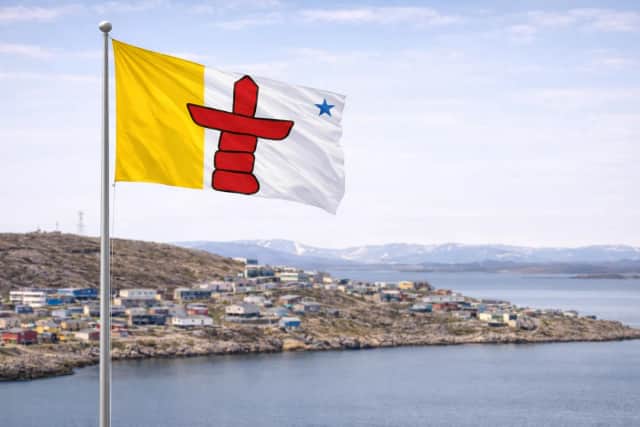
Flag Ceremonies: The distinctive Nunavut flag, featuring the inuksuk symbol and the North Star, is prominently displayed during celebrations.
Where It's Observed
Nunavut Day - Jour du Nunavut is a public holiday in 1 country. In 2031, it falls on Wednesday, July 9.
Fun Facts
- Nunavut means "Our Land" in Inuktitut, the language of the Inuit people
- The Nunavut Land Claims Agreement of 1993 was the largest land claims settlement in Canadian history
- Nunavut officially became Canada's newest territory on April 1, 1999, separating from the Northwest Territories
- Nunavut is the largest subdivision in Canada at approximately 2 million square kilometres, yet has only about 40,000 residents
- About 85% of Nunavut's population is Inuit, making it the only jurisdiction in Canada with an Indigenous majority
- Nunavut has no roads connecting it to the rest of Canada — all travel is by air or sea
- The territory's flag features an inuksuk, a traditional Inuit stone landmark used for navigation
Frequently Asked Questions
When is Nunavut Day?
Nunavut Day is celebrated on July 9 each year, marking the anniversary of the Nunavut Land Claims Agreement Act of 1993.
What does Nunavut mean?
Nunavut means "Our Land" in Inuktitut, the language of the Inuit people.
When did Nunavut become a territory?
Nunavut officially became Canada's newest territory on April 1, 1999, though the Nunavut Land Claims Agreement Act was passed on July 9, 1993.
What is the French name for Nunavut Day?
In French, Nunavut Day is called Jour du Nunavut.
Is Nunavut Day a statutory holiday?
Yes, Nunavut Day is a public holiday in Nunavut. Government offices and most businesses are closed.
Travel Inspiration
Planning a trip around Nunavut Day - Jour du Nunavut? Explore our travel guides for destinations where this holiday is celebrated.


