
Assumption of Mary
2027Sunday, August 15
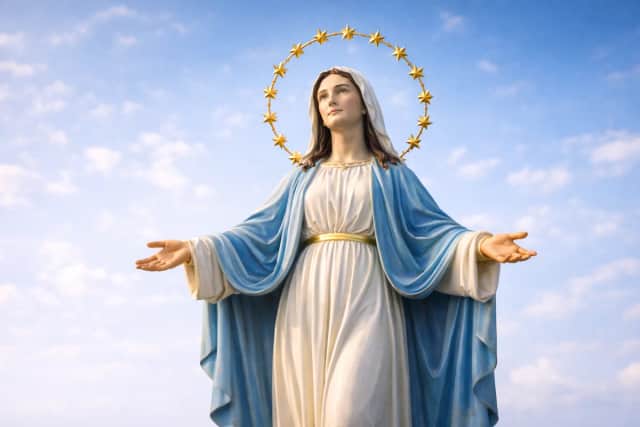
Quick Facts
- Date
- Sunday, August 15, 2027
- Observed in
- Austria, Belgium, Brazil, Switzerland, Chile +25 more
- Type
- Christian Holiday
What is Assumption of Mary?
The Assumption of Mary, celebrated on August 15, is one of the most important Marian feasts in Christianity. It commemorates the belief that the Virgin Mary was assumed body and soul into heavenly glory at the end of her earthly life.
This holy day is a major public holiday across Catholic Europe, from Italy's Ferragosto to Croatia's Velika Gospa and Austria's Mariä Himmelfahrt. It marks the peak of summer celebrations in many countries.
The feast combines deep religious devotion with vibrant cultural traditions including processions, pilgrimages, the blessing of herbs and flowers, and festive meals that bring families together.
When is Assumption of Mary 2027?
Assumption of Mary is on Sunday, August 15 in 2027. Check the dates and days for other years in the table below.
History & Origin
The belief in Mary's assumption into heaven developed in the early Christian Church, with evidence of its celebration dating to at least the 5th century. The feast was established in the Eastern Church before spreading to the West.
In 1950, Pope Pius XII proclaimed the Assumption of Mary as an official dogma of the Catholic Church through the apostolic constitution "Munificentissimus Deus," making it the most recently defined Catholic dogma.
The celebration on August 15 has ancient roots, possibly connected to older harvest festivals. Over centuries, it absorbed pre-Christian traditions of blessing the first fruits and herbs of the season.
In the Eastern Orthodox Church, this feast is known as the Dormition (falling asleep) of the Theotokos, celebrating Mary's death and assumption with a two-week fasting period.
How It's Celebrated
Ferragosto (Italy): The entire country takes a vacation. Beaches and mountains fill with families, and cities empty as Italians enjoy the peak of summer.
Processions: Religious processions carry statues of the Virgin Mary through streets in Spain, Portugal, Italy, and Latin America.
Blessing of Herbs (Kräuterweihe): In Germany, Austria, and Poland, bundles of herbs and flowers are blessed in church, believed to have healing properties.
Pilgrimages: Major pilgrimages occur to Marian shrines like Lourdes (France), Fatima (Portugal), Częstochowa (Poland), and Mariazell (Austria).
Velika Gospa (Croatia): Thousands walk barefoot to the shrine of the Virgin Mary in Sinj, fulfilling vows and seeking blessings.
Festive Meals: Families gather for elaborate meals featuring seasonal specialties and regional dishes.
Beach Day: In Mediterranean countries, August 15 is traditionally the biggest beach day of the year.
Fireworks: Many towns and villages celebrate with fireworks displays in the evening.
Where It's Observed
Assumption of Mary is a public holiday in 22 countries. In 2027, it falls on Sunday, August 15.
Fun Facts
- In Italy, Ferragosto dates back to 18 BC when Emperor Augustus established Feriae Augusti, a festival of rest after the harvest
- The blessing of herbs on Assumption Day is called Kräuterweihe in German and typically includes 7, 9, or 77 different plants
- In Sinj, Croatia, up to 30,000 pilgrims walk barefoot to the shrine each year on Velika Gospa
- The Assumption is celebrated as a public holiday in at least 20 countries worldwide
- In Guatemala, the day is marked by colorful kite festivals honoring departed souls
- Polish tradition holds that on this day, called Matka Boska Zielna, no herbs may be picked
- The dogma of the Assumption was defined only in 1950, making it the most recent Catholic dogma
- In some Austrian villages, horse-drawn carriages carry blessed herbs in procession through the streets
Frequently Asked Questions
Why is the Assumption of Mary celebrated on August 15?
The August 15 date has ancient origins, possibly connected to harvest festivals. The feast was established in the Eastern Church by the 5th-6th century and spread to Rome by the 7th century. The timing coincides with the harvest season, which is why the blessing of herbs and first fruits became part of the celebration.
What is the difference between Assumption and Dormition?
The Assumption (Catholic) and Dormition (Orthodox) both commemorate Mary being taken to heaven. The difference is in emphasis: Dormition (from Latin dormire, to sleep) focuses on Mary's death as a peaceful falling asleep, while Assumption emphasizes her being taken up body and soul into heaven.
Why is Ferragosto such a big deal in Italy?
Ferragosto combines the religious Assumption feast with the ancient Roman tradition of Feriae Augusti. Mussolini popularized organized group trips in the 1920s, establishing the tradition of Italians taking vacation around this date. Today, it's the peak of summer holidays when most businesses close.
What is the blessing of herbs tradition?
In German-speaking countries and Poland, bundles of herbs and flowers (Kräuterbuschen) are blessed in church on Assumption Day. This tradition combines Christian devotion with ancient beliefs in the healing power of plants harvested at this time. The blessed herbs are kept in homes for protection and healing.
Is August 15 a public holiday?
Yes, August 15 is a public holiday in many Catholic countries including Italy, Spain, France, Austria, Poland, Croatia, Portugal, Belgium, and others. In some countries it's called by different names: Ferragosto (Italy), Mariä Himmelfahrt (Austria/Germany), Velika Gospa (Croatia).
What is the significance of pilgrimages on this day?
The Assumption is one of the most important days for Marian pilgrimages. Major shrines like Lourdes, Fatima, Częstochowa, and Mariazell see their largest crowds. Many pilgrims walk long distances or even barefoot to honor Mary and fulfill vows made during the year.
Travel Inspiration
Planning a trip around Assumption of Mary? Explore our travel guides for destinations where this holiday is celebrated.


