

Learning how to maximize PTO days is one of the most valuable skills any traveler can develop — and it can mean the difference between a quick weekend getaway and a full two-week adventure without burning through your entire annual leave. Whether you’re working with a modest 10-day allowance or a generous 25-day package, strategic planning around public holidays, bridge days, and smart scheduling can dramatically extend your time away from the office. This comprehensive guide walks you through every proven technique to maximize PTO days, helping you travel longer, explore more, and return to work genuinely refreshed.
In this guide
- Why Learning to Maximize PTO Days Matters
- The Art of Holiday Stacking to Maximize PTO Days
- Using Bridge Days to Extend Your Vacation
- Annual PTO Planning: The Big Picture Strategy
- Maximize PTO Days Without Doing the Math Yourself
- Choosing Destinations That Reward Longer Stays
- Smart Travel Hacks That Save PTO Days
- Combining Remote Work With Extended Travel
- Navigating PTO Requests at Work
- Frequently Asked Questions About How to Maximize PTO Days
- Start Planning: Your Action Plan to Maximize PTO Days
⚡ Quick Tips: Maximize Your PTO Days
- 📅 Stack public holidays: Book time off around bank holidays to double your vacation length for free
- ✈️ Travel on weekends: Fly out Friday night and return Sunday — those days don’t cost PTO
- 🗓️ Plan a year ahead: Submit leave requests early to lock in peak dates before colleagues do
- 🌍 Use bridge days wisely: A single PTO day between two holidays can create a 5-day break
- 🧮 Skip the spreadsheet: Beevago works out your best vacation dates from your leave balance, your state and your profile
- 💡 Go long-haul strategically: Far-flung destinations justify longer trips — making each PTO day count more
- 🎟️ Ready to plan your next extended adventure? book experiences for your next long trip
- 🏨 Accommodation sorted: compare hotel prices for longer stays
- ✈️ Find the best fares: find cheap flights to kick off your extended vacation
Table of Contents
- Why Learning to Maximize PTO Days Matters
- The Art of Holiday Stacking
- Using Bridge Days to Extend Your Vacation
- Annual PTO Planning: The Big Picture
- Maximize PTO Days Without Doing the Math Yourself
- Choosing Destinations That Reward Longer Stays
- Smart Travel Hacks That Save PTO
- Combining Remote Work With Extended Travel
- Navigating PTO Requests at Work
- Frequently Asked Questions
Why Learning to Maximize PTO Days Matters
The average full-time employee in the United States receives between 10 and 15 days of paid time off per year — and a significant portion of workers don’t even use all of it. According to the U.S. Travel Association, Americans collectively forfeit hundreds of millions of vacation days annually. That’s not just a missed opportunity for rest; it’s leaving money, experiences, and mental health benefits on the table.
When you know how to maximize PTO days effectively, you unlock a completely different style of travel. Instead of cramming a rushed city break into a single long weekend, you can plan a slow-travel adventure through Southeast Asia, a multi-country European rail journey, or an in-depth exploration of South America — all without requesting more leave than your colleagues or burning out your goodwill with management.
The key insight is simple: your PTO days are only part of the equation. Weekends, public holidays, and smart scheduling are the multipliers that transform a modest leave allowance into genuinely extended travel time.
The Art of Holiday Stacking to Maximize PTO Days
Holiday stacking is the cornerstone strategy for anyone serious about getting more travel time from fewer leave days. The concept is straightforward: identify public holidays that fall near weekends, then use minimal PTO days to create an extended break.
How Holiday Stacking Works in Practice
Consider a public holiday that falls on a Thursday. By taking just one PTO day on Friday, you instantly create a four-day weekend — Thursday through Sunday. Now add the Wednesday before, and you have a five-day break using only two PTO days. That’s the power of strategic positioning.
Here are some of the most powerful stacking opportunities in the U.S. calendar:
- Thanksgiving (4th Thursday in November): Thanksgiving Thursday is a federal holiday, but the Friday after it is not — so take Monday–Wednesday plus that Friday — 4 PTO days — for a full 9-day break from Saturday to Sunday. If your employer closes on the Friday too, as many do, the same 9 days cost you only 3
- Christmas/New Year’s: Many offices slow down between December 25 and January 1 — using 3–4 PTO days can yield 10–12 consecutive days off
- Memorial Day (last Monday in May): Add the Tuesday and Wednesday after for a 5-day break using 2 PTO days
- Independence Day (July 4th): When it falls on a Tuesday or Thursday, a single PTO day creates a 4-day weekend
- Labor Day (first Monday in September): Take the Tuesday–Friday off for a 9-day break using just 4 PTO days
If you’re based in the UK, Europe, or Australia, your public holiday calendar will differ, but the principle remains identical. Map out your country’s bank holidays at the start of each year and look for clustering opportunities before you plan anything else.
Using Bridge Days to Extend Your Vacation
A “bridge day” is a single working day that sits between a public holiday and a weekend — and it’s arguably the most efficient PTO investment you can make. Using one bridge day can transform what would otherwise be a disjointed schedule into one seamless block of free time.
The Bridge Day Formula
Imagine a public holiday falls on a Tuesday. The Monday before it is your bridge day. Take that single Monday off, and you suddenly have four consecutive days — Saturday, Sunday, Monday (PTO), Tuesday (holiday). That’s a 4-day break for the cost of one PTO day. If the Friday before is also a holiday, that single leave day is buying you a 5-day stretch.
Many experienced travelers plan their entire year around bridge days. Once you start thinking this way, you’ll find opportunities throughout the calendar that most colleagues completely overlook. A good tip is to create a simple spreadsheet at the start of the year, listing every public holiday and the adjacent weekdays, then highlight the most efficient bridge day opportunities.
Annual PTO Planning: The Big Picture Strategy
To truly maximize PTO days, you need to think at the annual level rather than booking trips reactively. The most effective approach is what travel strategists call “PTO mapping” — laying out the entire year’s calendar in January and identifying every opportunity before you commit to anything.
Step-by-Step Annual PTO Mapping
- Download a full-year calendar and mark every public holiday in your country
- Identify all long weekends — where holidays fall on Mondays or Fridays
- Find bridge day opportunities — holidays on Tuesdays or Thursdays
- Decide on your big trip first — allocate your largest PTO block to your most ambitious destination
- Fill in smaller trips around the remaining holidays and weekends
- Submit leave requests early — ideally in January or February for the full year
A well-mapped year might look something like this: a 10-day trip to Japan using 6 PTO days (stacked around a holiday week), a 5-day European city break using 3 PTO days (bridge day strategy), and two long weekend getaways using 2 PTO days each. That’s four meaningful trips from just 13 PTO days — leaving you with buffer days for sick days or unexpected events.
Mapping that by hand is the slow part, and it is the part Beevago automates — same strategy, worked out from your own leave balance and holiday calendar in a few seconds.
When you’re ready to start booking, search for flights across your target travel dates early to lock in the best fares, and compare accommodation options for each trip before prices climb during peak booking windows.
Maximize PTO Days Without Doing the Math Yourself
Everything above works — but doing it by hand means opening a calendar, cross-checking public holidays against weekends, counting backwards from each one, and repeating that for all twelve months. Miss a single state holiday and the whole plan shifts. This is exactly the calendar math Beevago’s vacation planner was built to do for you: you enter what you have to work with, and it returns the specific date ranges that stretch your leave the furthest.
It Plans Around Your Actual Leave Balance
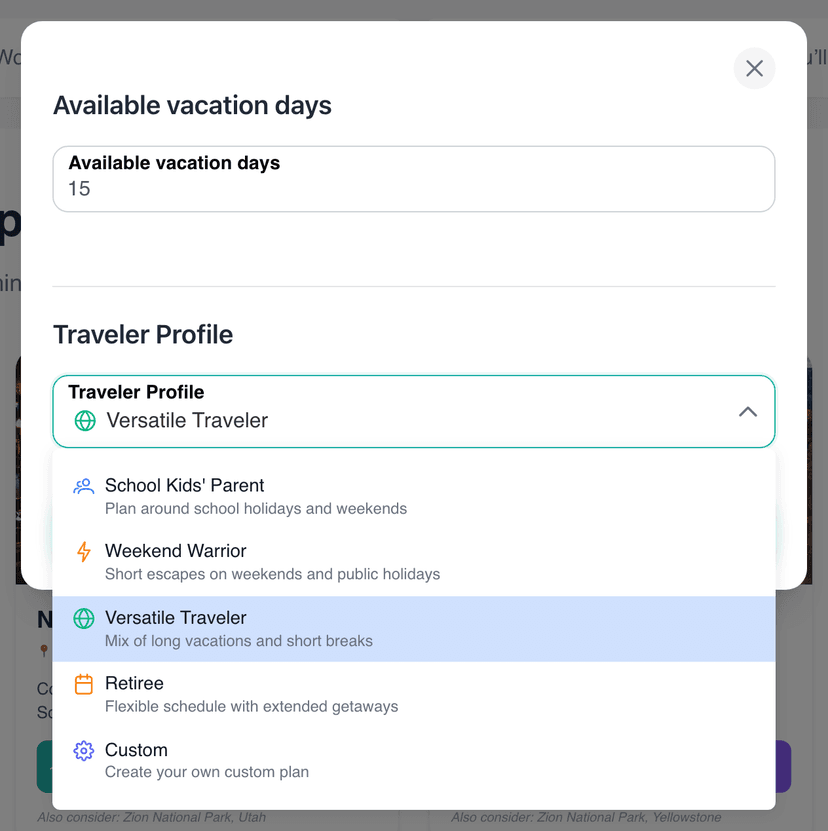
Rather than assuming a generic allowance, you tell the planner how many vacation days you actually have left. Ten days and twenty-five days produce genuinely different plans, so the recommendations always fit your real balance instead of a hypothetical one. You can also set a minimum length for what counts as a “long” trip, so the planner never hands you a two-day break when you were holding out for a proper week away.
It Adapts to the Kind of Traveler You Are
The same calendar suits different people very differently, so you pick the profile that matches your life and the results reorganize around it:
- School Kids’ Parent — plans around school holidays and weekends, so your time off lands when your children are actually free
- Weekend Warrior — favors short escapes built on weekends and public holidays over one long absence
- Versatile Traveler — balances a mix of long vacations and short breaks across the year
- Retiree — assumes a flexible schedule and leans toward extended getaways outside peak periods
- Custom — build your own plan when none of the presets describe your situation
It Knows Which Holidays Apply Where You Live
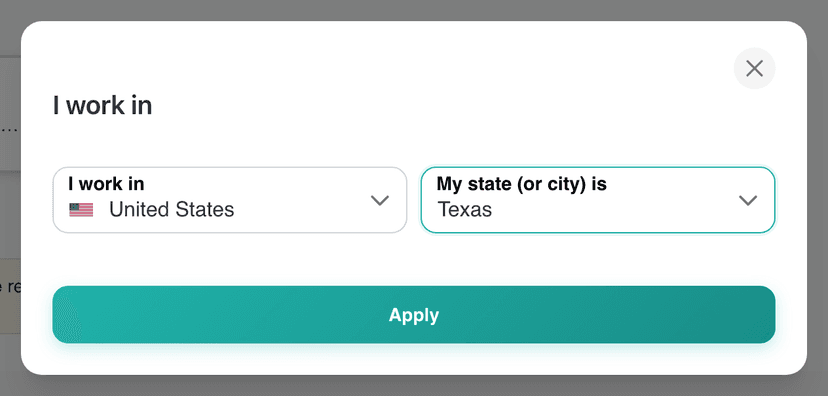
The US has eleven federal holidays, but the list that actually gets you a day off depends on your state. Good Friday is a holiday in Connecticut, Delaware, Hawaii, Indiana, Louisiana, North Carolina, New Jersey, Tennessee and Texas, among others — and simply another working day elsewhere. Beevago carries holiday data for all fifty states plus the District of Columbia, so the stacking opportunities it suggests are the ones that exist on your calendar, not someone else’s.
It Lets You Correct the Days You Actually Work
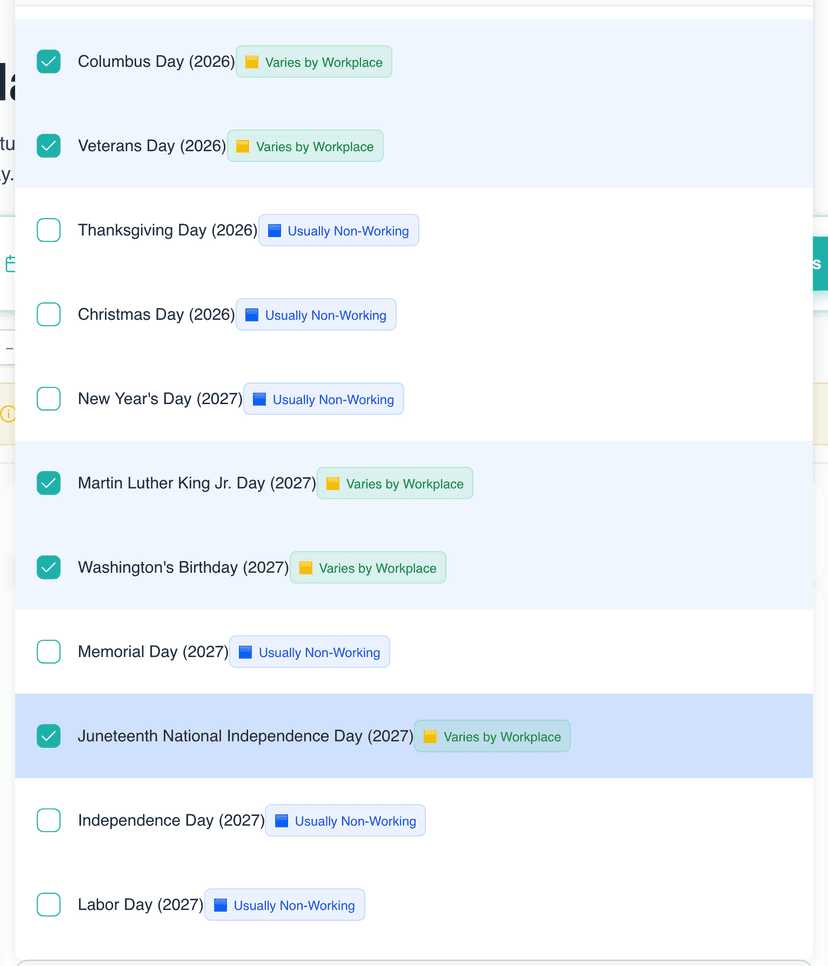
Plenty of people work days that are technically holidays, and plenty get days off that no official list recognizes. Common federal holidays are set as non-working by default, and from there you mark any holiday as a working day for your situation. Retail, healthcare and hospitality schedules rarely match the federal calendar, and this is what keeps the plan honest — a break built on a day you were always going to be at work is not a break.
It Works Well Beyond the United States
The same optimization runs on public and school holiday data for nearly eighty countries, with more being added over time. That matters if you moved countries mid-career, work for an employer whose holiday calendar follows another country, or split the year across two of them — and it means the strategy in this guide is not limited to the US federal calendar.
The practical difference is time and confidence: instead of an evening spent with a calendar and a notepad, you get a ranked set of date ranges showing how many days off each one produces and how many PTO days it costs. See your best vacation dates, then use the booking steps below to turn the winning dates into an actual trip.
Choosing Destinations That Reward Longer Stays
Not all destinations are created equal when it comes to PTO efficiency. When you’re investing significant leave days in a single trip, you want a destination that genuinely rewards the extra time — somewhere with enough depth, variety, and experiences to justify the journey.
Long-Haul Destinations Worth the PTO Investment
Long-haul destinations are often the smartest use of a large PTO block. The logic is simple: if you’re flying 12 hours to reach Southeast Asia, Japan, or New Zealand, you want to stay for at least two weeks to make the travel time worthwhile. Destinations like Thailand, Vietnam, and Indonesia offer incredible value, diverse landscapes, and enough cultural richness to fill 14 days with ease. Once you’ve booked your long-haul flights, you can plan activities and day trips to fill every day of your extended stay meaningfully.
Multi-Country Itineraries for Maximum Value
Another high-value strategy is the multi-country itinerary. Rather than spending 10 days in a single city, consider routing through two or three neighboring countries. A Central American trip might combine Guatemala, Belize, and Honduras. A Balkan adventure could weave through Slovenia, Croatia, and Montenegro. These itineraries keep things fresh, expose you to multiple cultures, and make every PTO day feel packed with new experiences.
For multi-destination trips, renting a car gives you the flexibility to move between destinations on your own schedule, while booking train connections in advance is often the smarter choice for European multi-city routes.
Slow Travel: Getting More From Each Destination
Slow travel is a philosophy that pairs beautifully with the goal of maximizing PTO. Instead of rushing through a checklist of tourist sites, slow travel means staying in one place for 4–5 days, exploring neighborhoods at leisure, eating where locals eat, and genuinely absorbing the culture. You’ll spend less on accommodation (weekly rates are often cheaper), feel less exhausted, and return home with richer memories than any whirlwind tour could provide.
Smart Travel Hacks That Save PTO Days
Beyond calendar strategy, there are several practical travel habits that help you maximize PTO days without sacrificing any vacation time.
Fly on Weekends — Always
One of the simplest rules for PTO efficiency: always depart on a Friday evening or Saturday morning, and return on a Sunday night. This way, your travel days don’t eat into your working week. Yes, Friday evening flights can be busy, but the trade-off is enormous — you preserve Monday through Friday for actual vacation time rather than spending PTO days sitting in airports.
Use Overnight Flights Strategically
Overnight flights — particularly on long-haul routes — are a PTO maximizer’s best friend. Departing on a Friday night and arriving at your destination Saturday morning means you’ve used zero PTO days for travel. The same logic applies on the return: a Sunday night red-eye that lands Monday morning means you can go straight to work (or take a half-day) without losing a full vacation day.
Book Refundable or Flexible Rates
Flexibility is a form of PTO protection. When you book accommodation with free cancellation, you can commit to your travel plans early (securing better prices) while retaining the ability to adjust if work demands shift. Many hotels and booking platforms now offer flexible rates at minimal or no premium — always worth selecting when you’re planning months in advance.
Combining Remote Work With Extended Travel
For those with remote or hybrid work arrangements, there’s an additional lever available: the “workcation.” By working remotely from your destination for part of the trip, you can extend your time abroad without using additional PTO days. A two-week trip might involve five days of remote work sandwiched between two long weekends — giving you 14 days in a new country while only using 5–7 PTO days.
This approach requires clear communication with your employer, a reliable internet connection, and honest time management. It works best in destinations with strong digital infrastructure — places like Lisbon, Medellín, Chiang Mai, and Bali have thriving remote work communities with excellent co-working spaces and fast Wi-Fi. When planning a workcation, look for accommodation with dedicated workspaces and reliable connectivity as your top priorities.
While you’re working, evenings and weekends are yours to explore — and you can book local experiences and tours for those free hours to make the most of your destination without compromising your work responsibilities.
Navigating PTO Requests at Work
Even the best PTO strategy falls apart if you can’t get your leave approved. Here’s how to navigate the workplace side of the equation.
Request Leave Early and Be Specific
The single most effective workplace habit for frequent travelers is submitting leave requests as early as possible — ideally at the start of the year. Many companies operate on a first-come, first-served basis for popular periods like Christmas and summer. By planning your PTO map in January and submitting requests immediately, you secure the dates you want before colleagues make competing claims.
Frame Your Time Off Professionally
When requesting extended leave, frame it in terms of coverage and continuity. Outline how your responsibilities will be managed in your absence, offer to brief a colleague, and demonstrate that projects will be on track before you leave. Managers are far more likely to approve extended PTO when they can see that operations won’t be disrupted.
Know Your Company’s PTO Policies
Understand whether your employer allows PTO rollover, payout of unused days, or “use it or lose it” policies. If you’re in a use-it-or-lose-it situation, that’s actually an argument for being more strategic — not less. Map your trips to ensure you use every day before the deadline, and don’t let a single PTO day go to waste.
Frequently Asked Questions About How to Maximize PTO Days
How can I maximize PTO days with only 10 days of annual leave?
With just 10 PTO days, strategic holiday stacking is your most powerful tool. By aligning your leave with public holidays and weekends, 10 PTO days can realistically yield 20+ days of actual vacation time across the year. Focus on three or four targeted trips rather than one big block, and use bridge days to create long weekends from single PTO days.
What is the best way to maximize a single PTO day?
The best way to maximize a single PTO day is to use it as a bridge day adjacent to a public holiday and a weekend. For example, if a holiday falls on a Tuesday, taking Monday off gives you a four-day break from Saturday to Tuesday. Alternatively, use a single PTO day to extend a long weekend into a five-day break with a budget flight to a nearby destination.
Is there a tool that works out how to maximize PTO days automatically?
Yes. Beevago’s vacation planner does this calculation for you: you enter how many vacation days you have, the state or country you live in, and which holidays you actually work, then choose a traveler profile — parent, weekend traveler, versatile traveler or retiree — and it returns the date ranges that turn the fewest PTO days into the most time off. It covers all fifty US states plus DC and nearly eighty countries, so you do not have to check a holiday calendar by hand.
How do I plan a long international trip without using too many PTO days?
Target your long international trip around a holiday cluster — Christmas/New Year, Thanksgiving, or a week with multiple public holidays. Use overnight flights on departure and return to avoid burning PTO days on travel. A 14-day international trip is achievable with as few as 8–10 PTO days when stacked correctly with holidays and weekend travel days.
Is it worth taking unpaid leave to extend a vacation?
For many travelers, a few days of unpaid leave for a once-in-a-lifetime trip is absolutely worth it. If you’re already investing in flights and accommodation to a far-flung destination, an extra 3–5 unpaid days might cost far less than you’d expect — and the experience gained is irreplaceable. Always check your company’s policy on unpaid leave and plan your finances accordingly.
How do remote workers maximize PTO days differently?
Remote workers have a significant advantage: the workcation. By working remotely from a destination for part of a trip, remote employees can extend their time abroad without consuming PTO. A trip that might require 10 PTO days for an office worker might only need 5 for a remote worker who works normal hours from a café in Lisbon or a co-working space in Bali.
Start Planning: Your Action Plan to Maximize PTO Days
The difference between a traveler who feels perpetually time-starved and one who seems to always be heading somewhere incredible often comes down to one thing: planning. When you know how to maximize PTO days, your annual leave allowance — however modest — becomes a powerful travel tool.
Here’s your immediate action plan:
- Pull up next year’s calendar right now and mark every public holiday
- Identify your top three holiday stacking opportunities
- Decide on your one big trip and two or three shorter getaways
- Submit your leave requests as soon as possible
- Search for flights on your target dates and set price alerts
- Browse accommodation options and book refundable rates early
- Explore activities and experiences at each destination to build your itinerary
Travel doesn’t have to be reserved for the lucky few with unlimited vacation time. With the right strategy, even the most time-constrained employee can see the world — one well-planned PTO day at a time. Start mapping your year today, and watch how quickly those modest leave days transform into extraordinary adventures.
Ready to turn your PTO strategy into real trips? Start by letting Beevago find your best vacation dates, then Find the best flight deals for your upcoming travel dates, compare hotels and lock in great rates, and discover unforgettable experiences at your destination. Your next great adventure is closer than you think.


